Why Total Cost of Ownership Matters
By Charles Drummond, CEO, AviusULD
Author’s Perspective
I’ve spent much of my career looking at ULDs from two very different perspectives.
Before joining AviusULD, I managed one of the world’s largest ULD fleets within a ULD management company. Today, I lead a manufacturer that designs and builds ULDs for airlines and cargo operators around the world.
What strikes me is how often the industry still evaluates ULDs using only one of the numbers that ultimately determines value.
The purchase price is easy to compare. It appears clearly on a quotation. It fits neatly into a procurement spreadsheet. It can be benchmarked against competing suppliers in a matter of minutes.
The costs that matter most rarely appear in the same place.
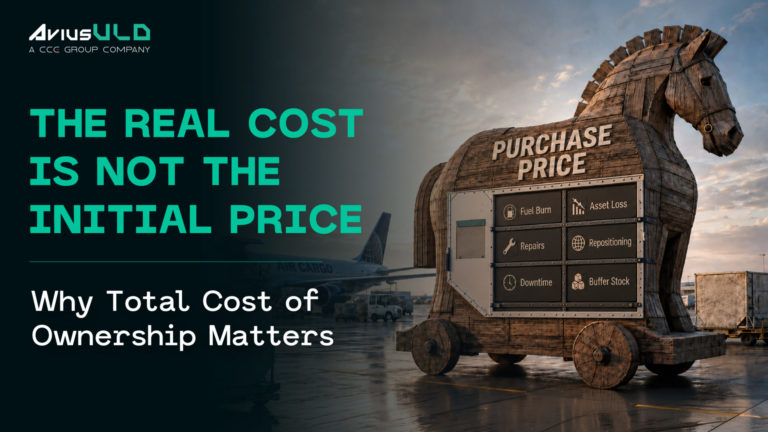
They show up years later through repairs, fuel consumption, asset losses, excess buffer stock, repositioning, downtime, maintenance administration, and shortened service life. They accumulate gradually, often across multiple departments, making them harder to see and even harder to measure.
Yet those costs ultimately determine whether a ULD is a good investment.
For many years, discussions around ULD procurement focused primarily on cost. More recently, sustainability has become a separate conversation. Airlines face growing pressure to reduce emissions, improve reporting, and demonstrate environmental progress across their operations.
What has become increasingly clear is that these conversations are converging.
The same characteristics that reduce lifecycle cost often reduce environmental impact as well. Lower weight reduces fuel consumption. Better durability reduces waste. Improved repairability extends product life. Better visibility reduces unnecessary repositioning and excess inventory.
The result is that Total Cost of Ownership and sustainability are becoming closely linked.
This article explores why that matters, what airlines should be measuring, and how lifecycle thinking is reshaping the way ULDs are designed, evaluated, and managed.
The Cost of Looking at the Wrong Number
Every airline understands the importance of lifecycle economics when evaluating aircraft, engines, or major infrastructure investments. Few organizations would choose a fleet purely because it offered the lowest purchase price.
A ULD spends its life moving through one of the harshest operating environments in commercial aviation. It is loaded, unloaded, stacked, dragged, pushed, lifted, stored, transported, and exposed to weather and handling conditions that vary significantly across the world.
Every one of those interactions has the potential to create cost.
Some costs are obvious. Repair invoices are easy to identify. Lost ULDs eventually need replacement. Damaged components require labor and spare parts.
Other costs are less visible.
A ULD waiting for repair is unavailable for use. A ULD sitting in the wrong station may require repositioning. A ULD that cannot be located often leads operators to hold additional buffer stock. A heavier ULD consumes fuel every time it flies.
Individually, these costs may appear manageable. Across a fleet of thousands of assets operating continuously across a global network, they become significant.
The global ULD fleet consists of approximately one million units with a replacement value exceeding USD 1 billion. Managing assets at that scale requires more than simply controlling acquisition cost. It requires understanding how those assets perform throughout their operational lives.
IATA estimates that annual global ULD repair and loss costs amount to approximately USD 330 million, excluding the wider impact of aircraft damage, delays, and cancellations linked to ULD operations.
That figure alone demonstrates the scale of the issue.
More importantly, repair spend should be viewed as the start of the cost chain rather than the end of it.
A repair event generates labor requirements, administrative work, spare parts consumption, inspection activity, transportation, and downtime.
Geography also matters. A damaged ULD often needs to move through a repair network before it can return to service. The farther that network sits from the point of damage, the more transportation, coordination, and downtime become part of the economic equation.
In some cases, the airline may also need to reposition a replacement unit elsewhere in the network to maintain operational continuity.
The true economic impact extends far beyond the repair itself.
This is one reason why airlines often underestimate the long-term consequences of design decisions.
A panel material that damages more easily may increase repair frequency. A component that takes longer to replace may increase downtime. A design that requires specialized parts may increase inventory costs. A heavier structure may consume more fuel over thousands of flight cycles.
None of those consequences appear in the initial purchase price.
They emerge gradually over years of operation.
When viewed through that lens, the cheapest ULD can become the most expensive one.
The most effective procurement decisions therefore evaluate the entire lifecycle rather than the initial transaction. They consider how the asset behaves after it enters service, how often it requires intervention, how efficiently it moves through the network, and how long it remains productive.
Those questions provide a far more accurate picture of value.
Why TCO and Sustainability Are Becoming the Same Conversation
For many years, cost and sustainability were often treated as separate priorities.
One belonged to finance. The other belonged to environmental reporting.
Today, they increasingly influence the same decisions.
Weight provides perhaps the clearest example.
Every kilogram loaded onto an aircraft must be carried. That reality affects fuel consumption, operating cost, payload capability, and emissions simultaneously.
AviusULD recently conducted a Product Footprint Assessment in accordance with ISO 14040 and ISO 14044 standards. The results highlighted something that surprised many people.
While manufacturing emissions remain important, the assessment demonstrates that operational performance is overwhelmingly the largest driver of environmental impact over the life of the asset. More than 99% of a ULD’s lifetime carbon footprint came from the use phase rather than manufacturing or end-of-life treatment.
In simple terms, the environmental impact of a ULD is overwhelmingly determined by the fuel required to transport it throughout its operational life.
Weight therefore influences both sustainability and economics through exactly the same mechanism.
The assessment compared AKE containers manufactured using Aluminum, Herculight, and Endumax panel materials.
The lifetime carbon footprint of an Endumax AKE was calculated at 339,161 kg CO₂-eq. Herculight measured 358,843 kg CO₂-eq. Aluminum measured 421,411 kg CO₂-eq.
Much of that difference comes from weight.
A lighter ULD requires less fuel to transport. Less fuel means lower operating cost and lower emissions.
Weight also affects payload capacity. Every kilogram allocated to equipment is a kilogram that cannot be used for revenue-generating cargo or baggage. In weight-constrained operations, lighter ULDs can help preserve valuable payload capacity while improving fuel efficiency.
The relationship is remarkably straightforward.
As air cargo demand continues to grow, the significance of those savings increases.
More cargo means more flights. More flights mean more opportunities for weight-related savings to accumulate.
The same pattern appears when examining durability.
A durable ULD remains in service longer. Fewer repairs reduce maintenance expenditure. Fewer repairs also reduce material consumption, transportation requirements, spare parts demand, and waste generation.
Repairability creates similar benefits.
A repairable product returns to service faster. Faster repairs reduce downtime. Reduced downtime improves asset utilization. Higher utilization reduces the number of spare units required to support the same operation.
The environmental benefit follows naturally. Extending product life reduces replacement demand and lowers the resources required to manufacture new assets.
Visibility has become another important example.
Historically, airlines often compensated for uncertainty by owning more ULDs than they theoretically needed. Assets would disappear into warehouses, freight forwarder facilities, or off-airport locations. Additional inventory became a form of insurance against poor visibility.
Buffer stock serves an important operational purpose, but it also carries a cost. Every additional ULD represents capital that has been purchased, stored, maintained, and managed.
Perhaps the most overlooked cost driver is fleet size itself.
Every day a ULD spends in repair, storage, transit, or waiting for inspection is a day it is unavailable for service. As availability decreases, airlines must hold additional assets to maintain operational continuity across their networks.
Conversely, a ULD that spends less time out of service can support more flight cycles throughout its life. Higher availability enables the same operation to be supported with fewer assets, reducing capital investment, storage requirements, maintenance exposure, and overall fleet management costs.
This is one of the reasons why Total Cost of Ownership analysis should extend beyond direct operating costs. Some of the most significant savings are created by reducing the number of assets required to support the same level of activity.
This relationship between availability and fleet size is often hidden, yet it can have a greater financial impact than the direct cost of repairs themselves.
Modern tracking technologies are changing the equation.
When visibility improves, airlines can make better decisions about where assets are located and how they are being used, reducing the need for excess inventory across the network.
Better visibility allows operators to make more informed decisions about asset deployment, positioning, and utilization. Greater confidence in asset availability can reduce buffer stock requirements and improve network efficiency.
The sustainability benefits emerge through the same process. Fewer unnecessary movements, fewer excess assets, and better utilization all contribute to lower resource consumption.
When viewed through a lifecycle lens, sustainability stops feeling like an additional objective.
It becomes a natural outcome of efficient asset management.
What Airlines Should Really Measure
The aviation industry has become increasingly sophisticated in how it measures performance.
Fuel efficiency, aircraft utilization, on-time performance, and load factors are monitored with extraordinary precision. Yet ULD procurement decisions are still sometimes influenced by a surprisingly narrow set of metrics.
Purchase price remains important.
Weight remains important.
Neither tells the full story.
A more complete evaluation should consider how an asset behaves throughout its life.
Questions worth asking include:
- How long is the expected service life?
- How frequently does the asset require repair?
- What is the average repair cost?
- How long does repair typically take?
- How readily available are spare parts?
- How many components are interchangeable?
- How much fuel is consumed over the asset’s life?
- How much buffer stock is required?
- What is the expected loss rate?
- How effectively can the asset be tracked?
- What happens at end of life?
- How much value remains after years of operation?
These questions often reveal a very different picture than acquisition cost alone.
Consider a premium lightweight container.
Its purchase price may be higher. Over time, however, lower fuel consumption, fewer repairs, longer service life, and higher utilization may generate a substantially lower lifecycle cost.
The opposite can also be true.
A lower-cost asset may appear attractive initially but generate higher operating costs throughout its life.
Neither outcome should be assumed. Both should be modeled.
The same principle applies whether an airline owns, leases, pools, or outsources management of its ULD fleet. Repair, repositioning, visibility, utilization, and loss-related costs do not disappear under different commercial structures. They simply appear in different places. Understanding the underlying drivers remains essential regardless of how the assets are financed or managed.
The most useful TCO analysis does not attempt to identify a universally superior solution. Different networks place different demands on their equipment. Long-haul operators face different challenges than regional carriers. Express networks behave differently than traditional cargo operations. Maintenance capabilities vary significantly between organizations.
The objective is understanding how a specific asset performs within a specific operation.
That is where lifecycle modeling becomes valuable.
It transforms procurement from a purchasing exercise into an operational decision.
The Future of ULD Ownership
The role of the ULD is changing.
For decades, the industry largely viewed ULDs as passive equipment. They were necessary assets, but rarely strategic ones.
That perception is evolving.
Airlines today face rising fuel costs, growing sustainability expectations, increasing cargo volumes, labor challenges, and greater pressure to optimize asset utilization. Every part of the operation is being examined more closely.
ULDs are part of that conversation.
Safety is becoming a larger part of the discussion as well. ULDs are aircraft components, and their performance influences cargo integrity, operational reliability, aircraft protection, and regulatory compliance. The financial consequences of a safety event can extend well beyond the immediate incident, reinforcing the importance of durability, airworthiness, and risk mitigation throughout the asset lifecycle.
The next generation of ULD management will place greater emphasis on lifecycle performance, operational visibility, and measurable outcomes.
Weight will continue to matter.
Durability will continue to matter.
Repairability will continue to matter.
Visibility will continue to matter.
At AviusULD, that philosophy shapes the way products are developed.
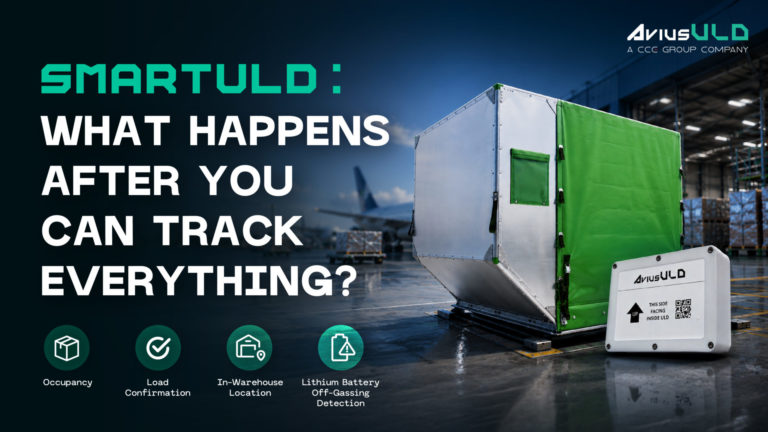
Endumax was designed to combine extremely low weight with exceptional durability. Herculight provides a balance between weight, repairability, and cost. Our Fire Resistant Containers (FRCs) are engineered to provide enhanced safety while remaining practical to maintain and operate. SmartULD extends the conversation beyond physical equipment by helping operators understand where assets are located and how they are being used.
Although these products address different challenges, they share a common principle.
Value is created over the life of the asset.
That perspective influences everything from material selection and modular construction to repairability, component standardization, and digital visibility.
The industry’s understanding of sustainability is evolving in a similar direction.
Increasingly, sustainability is being evaluated through measurable operational outcomes rather than broad statements of intent. Airlines want evidence. They want data. They want to understand how a product affects emissions, fuel consumption, maintenance requirements, and resource utilization throughout its life.
Lifecycle thinking provides those answers.
The question is no longer what a ULD costs to buy.
The more important question is what it costs to operate.